USEI @World Space Business Week 2026
Managing Critical Ground Infrastructure in Contested Environments: A Q&A with Ben Pigsley »
As satellite communications infrastructure becomes increasingly critical to government, defense and commercial networks, ground infrastructure operators face a growing range of threats—from severe weather and equipment failures to cyberattacks and physical disruptions.
At a recent industry discussion on “Managing Critical Ground Infrastructure in Contested Environments,” Ben Pigsley, President & CEO of U.S. Electrodynamics (USEI), discussed how teleport operators can prepare for disruption, balance geographic and physical diversity with customer requirements, and maintain service when normal operating conditions can no longer be assumed.
Pigsley emphasized that resilience is ultimately driven by customer requirements, service-level agreements and the ability to adapt when unexpected events occur.
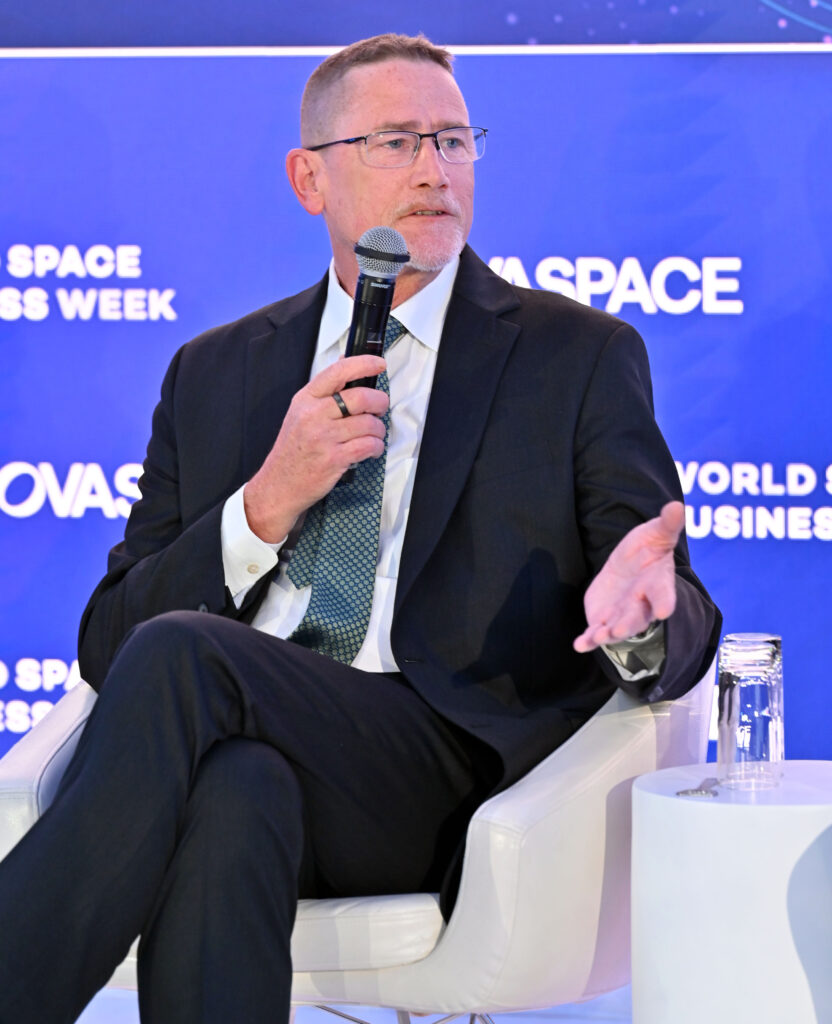
Q: From the perspective of a teleport, what does the term “contested environment” mean in practical business and operational terms?
Ben Pigsley: I think there are really two flavors. You have natural events—severe weather, disasters, or even equipment failures. I would still classify something like a fiber cut as a natural event.
Then you have the more nefarious types of events, such as cyberattacks on our networks, which have obviously become more sophisticated. With AI, our defenses are probably not at the level they need to be to address today’s offensive cyberattacks.
We are always exploring ways to better defend our networks. We have what’s called a Cooperative Research and Development Agreement with the United States Military Academy, with sponsorship from the U.S. Department of Energy, working on hashgraph technology along with distributed ledger technology to create networks that are much less vulnerable to attack.
So both types are important. Most teleports and infrastructure are built to withstand natural events to some degree, and they’re also built to defend against cyber events. But as those cyber threats become more sophisticated and demanding of our attention, that’s where we feel the focus needs to be.
Q: What is the right balance, if there is one, between fixed infrastructure, geographic diversity and operational flexibility when it comes to building for resilience?
Ben Pigsley: I don’t think there’s one right answer for all. There’s a right answer for each company and each customer.
Customers define the requirements. When designing for a customer who needs fully redundant and reliable five-nines availability, thera are many different aspects to take into consideration.
You have to make decisions based on service-level agreements you have with your customers and the customers you’re supporting.
I was a customer of USEI for 15 years before I joined the company. One of the reasons I joined was that we had grown with USEI as a customer, and they had learned over the years what it meant to be highly reliable and highly available.
Our customer base generally doesn’t have a lot of contracts directly with the government. Most of our customers are dealing directly with government customers. So, not to be dramatic about it, but some of those customers are in life-and-death situations.
The customer who needs that level of availability is going to pay for it. You’re not going to build that level of redundancy into your network if it isn’t needed.
As an example from a geographic perspective, we had an important customer who needed very high availability. We were on the West Coast of the United States, and the customer wanted more redundancy and geographic diversity. Our leadership looked at purchasing a property and facility on the East Coast in order to serve that customer. That ultimately brought us more business because of the geographic diversity.
When it comes to physical diversity—power, fiber and other infrastructure—we build our networks with what I call a “belt and suspenders” approach: primary, secondary and tertiary options for both power and fiber connectivity.
Again, it all comes down to the customers you serve and the decisions leaders make based on the service-level agreements they have with those customers.
Q: What should customers expect from you as a ground infrastructure partner when normal performance can no longer be assumed?
Ben Pigsley: There’s an old military adage that no plan survives first contact. But you have to have those plans in place.
We work with all of our customers upfront when we’re contracted for service to, first, define the service-level agreements and then walk them through contingencies: what their preferences would be, what would be available, and how we would respond.
The other part of that is having processes, both internally and externally, to communicate what’s happening, describe the problem and keep the customer informed.
Our customers know the world isn’t perfect and that things are going to happen. You have to have those plans, but those plans also have to be fluid. You have to be able to react and do the best you can.
Building a system that would be ready for every possible contingency isn’t possible. But communication and building those plans in concert with your customer is important. That’s what we do.
Q: Compared with GEO or LEO service architectures, which one provides a more robust or resilient service level in the ground segment?
Ben Pigsley: We service all orbits. We have customers operating LEO, MEO and GEO systems, and we recently did testing with a customer in HEO.
From a ground perspective, I don’t think there’s a lot of difference.. The equipment may be different, but from a reliability and performance perspective, I would expect the same service level from all suppliers, regardless of the orbit.
Building Resilience Into the Ground Segment
For Pigsley, resilience is not about designing a single solution that can withstand every conceivable threat. Instead, it requires an understanding of the customers’ requirements, building appropriate levels of redundancy and diversity, and establishing clear contingency and communications plans.
As satellite networks expand across multiple orbits and become increasingly integrated into critical communications infrastructure, the ground segment remains a key part of ensuring continuity of service. For teleport operators, that means preparing not only for equipment failures and severe weather, but also for increasingly sophisticated cyber threats and other disruptions.
The challenge, Pigsley suggests, is finding the right level of resilience for each customer—and making sure the plans, infrastructure and partnerships are flexible enough to respond when the unexpected happens.